

Confidential Computing: Data in Use Secure in the Cloud
Technological substitute for trust: How confidential computing protects data even while it is being processed
Confidential computing minimizes the potential security risk when processing data in conventional cloud infrastructures. The technology enables verifiable protection for “data in use,” i.e., for data while it is being processed. As a result, data in the cloud is no longer protected only at rest and in transit, but also during processing. Confidential computing marks a paradigm shift in cloud security: away from purely contractual trust in cloud operators and toward cryptographically verifiable security.
The Missing Component in the Cloud Security Model
Existing cloud security measures reliably protect data at rest and in transit but not when in use. When data is loaded to memory (RAM) for processing, it is available in unencrypted form and therefore openly accessible to cloud administrators or in the event of targeted attacks. Previously, anyone moving their data to third-party infrastructures had to rely on trust in the operator – a contractually regulated promise, but not a technical guarantee.
However, with increasing digitization and growing pressure toward cloud migration – particularly in highly regulated sectors such as public administration or the defense industry – trust is not enough. Confidential computing addresses this challenge technologically: Data is protected in hardware-based security zones even when it is being actively processed. The cloud operator is technically excluded from access to the processed data. Security therefore no longer rests on assurance, but on cryptographically verifiable isolation.
What is confidential computing?
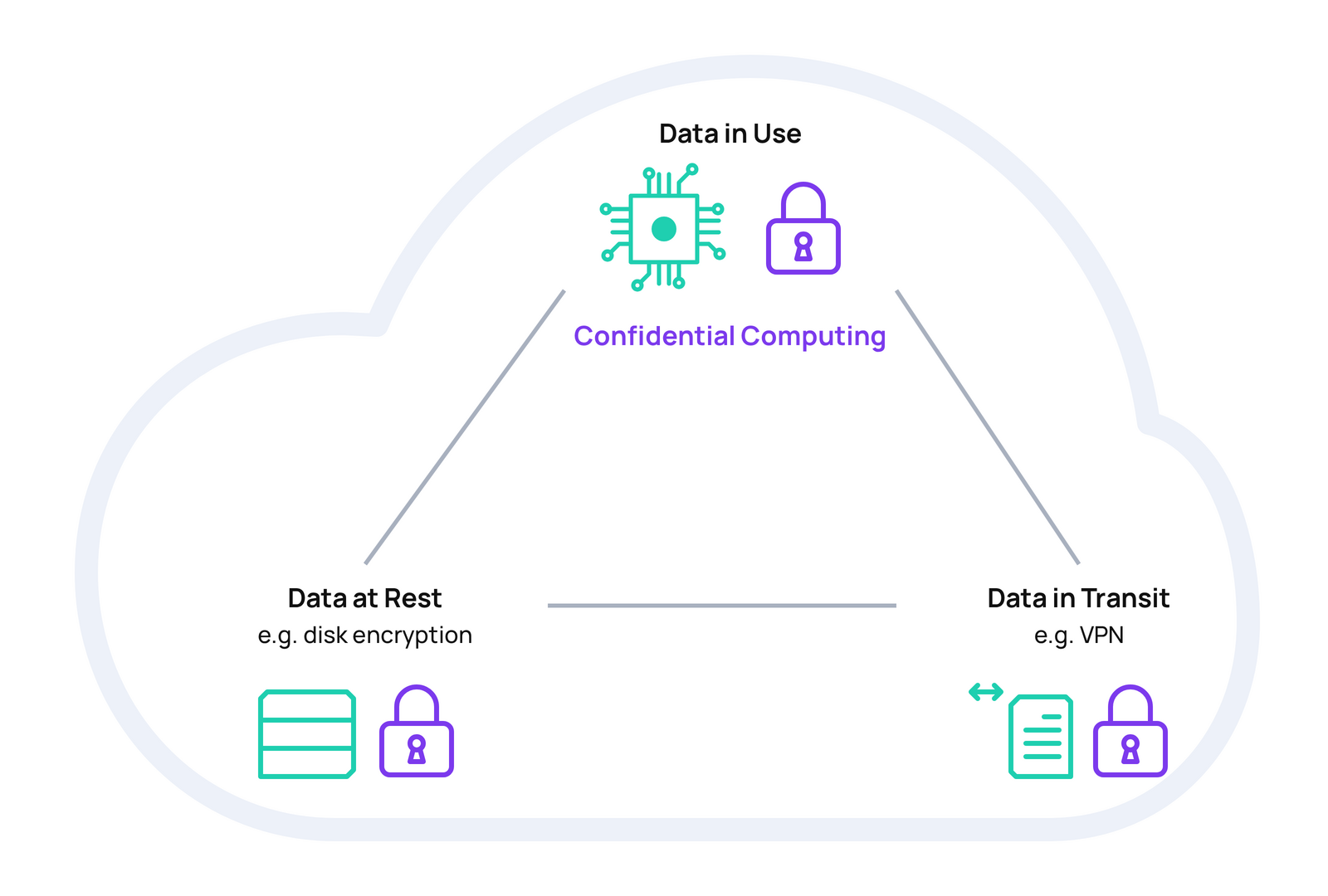
Confidential computing is a technology that protects data while it is being actively processed, i.e., while in the data-in-use state. Processing takes place within a hardware-based, attested and trusted execution environment. This prevents unauthorized access to and modification of applications and processed data. In combination with already established protective measures, confidential computing completes the so-called 3D security model, which ensures seamless encryption across all three data states:
Data at Rest: e.g., on encrypted hard drives,
Data in Transit: e.g., via a VPN,
Data in Use: while being processed in the working memory.
Established methods such as full-disk encryption and VPNs reliably cover the first two states. Data in use, by contrast, has long been a blind spot of cloud security and therefore the starting point of the actual challenge.
Threat scenarios
Why do we need confidential computing?
Public administration would also like to benefit from digitization in the same way the economy has done for many years. However, progress has lagged behind. The German Federal Office for Information Security (BSI) sees cloud computing as the central backbone of future-proof administration. A study by the market research firm Lünendonk shows how far public administration has come: cloud transformation is highly relevant for 80% of public administration bodies, and 71% are already developing a cloud strategy and have started using cloud services. Only 18%, however, use cloud services extensively. (Source: Lünendonk & Hossenfelder, “Cloud-Transformation im öffentlichen Sektor,” 2025. German only)
The days of classic IT infrastructures are long gone: Confidential cloud computing is a technical way of also transferring particularly vulnerable administrative processes safely to the cloud. Many of these processes, such as those with German classification level “Restricted,” still run isolated on their own hardware because regulatory issues hinder cloud migration. The key problem is the processing of sensitive data in shared infrastructures.
This gives rise to three threat scenarios:
- Unauthorized access by cloud administrators: Privileged system access means that cloud providers can potentially view data while it is actively being processed in RAM.
- Multi-tenant risks: Workloads of different tenants that are running on shared hardware may under certain circumstances be influenced by each other via side channels. Confidential scenarios currently require physical separation through dedicated servers for each tenant, which drives up cost and operational effort.
- Side-channel attacks: Specialized hardware attacks such as Spectre or Meltdown exploit implementation vulnerabilities in modern processors to access protected memory.
Where Hardware and Cryptography Meet
How does confidential computing work?
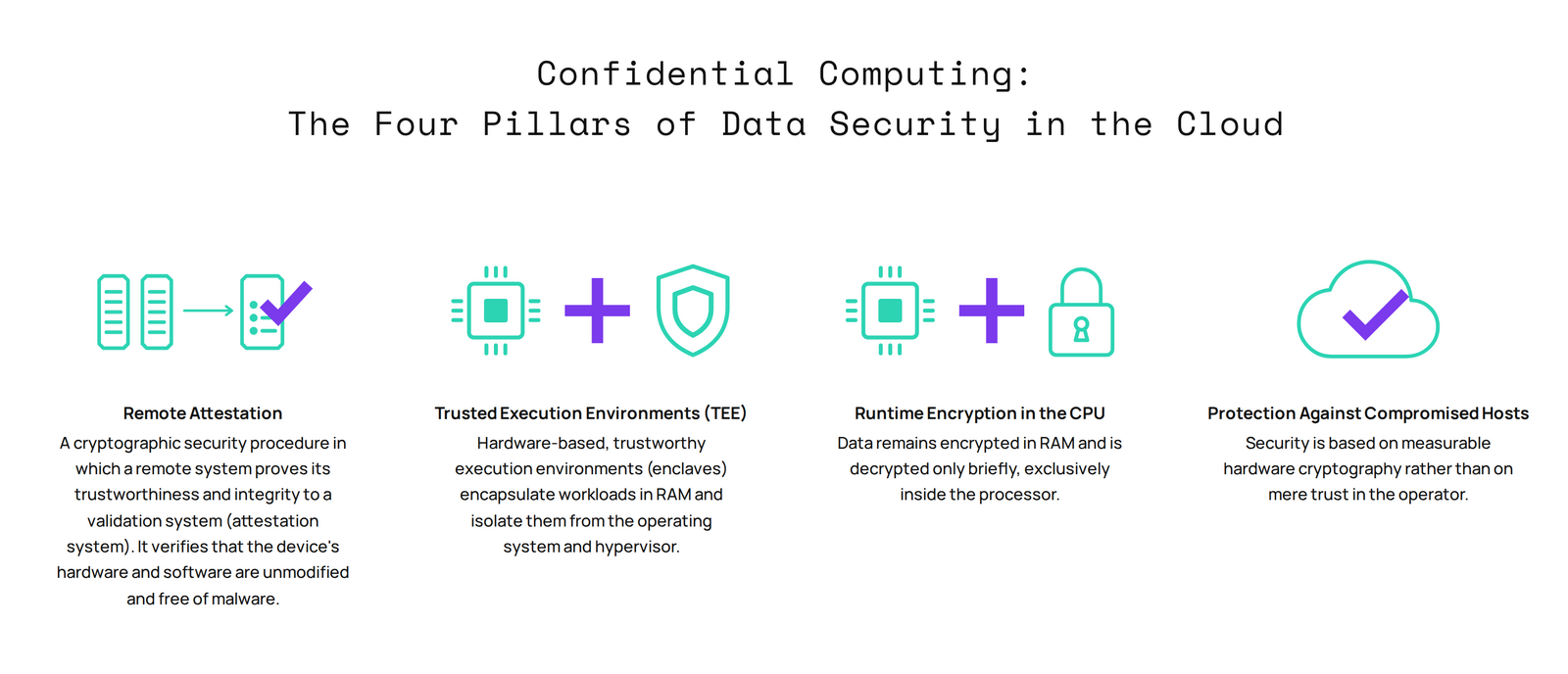
As soon as data to be processed is loaded into memory, it exists in unencrypted form and is vulnerable to memory dumps, compromised root access and targeted attacks. This is where confidential computing comes in: A hardware-based trusted execution environment (TEE), remote attestation and runtime encryption protect the data while it is being processed.
TEEs use special features of modern processors to isolate and fully encrypt the memory area of the enclave. This creates a secure execution environment that remains invisible to the rest of the system, including the cloud operator.
Remote attestation provides cryptographically demonstrable verification: Only authorized, checked code runs in a verifiably intact and tamper-free environment. This method ensures that the security promise of the enclave can be checked and is technically resilient.
Runtime encryption keeps the data encrypted in RAM throughout the processing cycle. The CPU decrypts the data only at the moment the actual calculation takes place and encrypts it again immediately when it leaves the processor.
Because hardware and cryptography work together this closely, the security of the cloud infrastructure becomes measurable and no longer depends on a relationship of trust with the operator.
Regulatory Enabler
Confidential Computing as an Enabler for the Public Sector and Defense
For public authorities and organizations under classified information protection, confidential computing is more than just a security technology – it is a regulatory enabler. The BSI has recognized confidential computing as a valid way of protecting data in use when federal administration bodies use cloud solutions for classified information.
Cloud Enabler for German Classification Level “Restricted”
- Hardware-based sovereignty with BSI approval: shielding contents with German classification level "Restricted" against unwanted access
- End-to-end encryption of data in transit, in use and in memory
- Technological substitute for trust: cryptographic security instead of pure trust in the cloud operator
- Ecosystem for the deployment of off-the-shelf cloud technologies in regulated environments
- Catalyst for innovation in public authorities: secure access to cloud resources without compromising the protection of classified information.
Aspect | Conventional Cloud Security | Confidential Computing |
|---|---|---|
| Scope of protection | Data at rest and data in transit | Additionally: data in use |
| Basis of trust | Contractual assurance provided by the operator ("security by contract") | Cryptographically demonstrable verification (remote attestation) |
| Operator access | Technically possible, contractually forbidden | Technically impossible |
| Tenant separation | Physical separation often necessary | Secure logical separation on shared hardware |
| Regulatory compliance (German classification level "Restricted") | Possible to a limited extent | BSI-recognized approach for data-in-use protection |
FAQ
How Does Hardware Isolation Work in Confidential Computing?
Isolated areas within the hardware, known as trusted execution environments (TEEs) or enclaves, form the technical core of hardware isolation. Special features of modern processors enable certain areas of memory to be reserved and fully encrypted for an enclave. This protects workloads in RAM against external access and modification.
What Does Remote Attestation Mean and Why Is It Important?
Remote attestation is a cryptographic procedure that confirms before the start of data processing that only authorized code is executed in an intact and tamper-free hardware environment. Without attestation, it would not be possible to check the security promise of an enclave. Attestation makes trust in the execution environment verifiable and therefore resilient.
Which Problems Does Confidential Computing Solve?
- The "security vulnerability" in data processing
- The "question of trust" toward cloud providers
- Risks due to shared infrastructures (multi-tenancy)
- Protection against specialized hardware attacks
- Regulatory obstacles for public authorities and defense
- Protection of intellectual property and artificial intelligence
How Does Confidential Computing Affect the System Architecture?
Confidential computing changes where and how trust is anchored in an IT architecture. Instead of trusting the entire software stack – consisting of operating system, hypervisor and cloud platform – the trusted computing base (TCB) is reduced to the hardware itself. This has consequences for architecture design: Applications must be structured in such a way that components requiring protection can be clearly separated from non-critical components and moved to enclaves. Remote attestation becomes an integral element of the system design.
What Is The Difference Between TEE and Confidential Computing?
A trusted execution environment (TEE) is the underlying hardware component, i.e., a hardware-based, isolated runtime environment. Confidential computing is the generic term for data-in-use protection by means of TEEs. A TEE is the technical means, and confidential computing is the security paradigm.
What Is the Difference Between Conventional Cloud Security and Confidential Computing?
Conventional security solutions protect data at rest as well as data in transit. During actual processing in memory, however, the data is unprotected. Confidential computing closes this gap using hardware-based isolation and makes protection cryptographically verifiable. The main difference is that security rests not on contractual trust in the operator, but through technical guarantees.
How Does Confidential Computing Work in the Cloud?
In cloud environments, confidential computing runs on the physical hardware of the provider, but in such a way that providers themselves cannot access the processed data. The enclave is set up directly on the processor of the cloud server, while the provider’s hypervisor and operating system remain excluded. For users, this process is transparent: In many cases, existing applications can run in a confidential computing environment without any changes, e.g., as a confidential VM, in Linux-based container environments such as Kubernetes, or as an isolated enclave on the provider’s physical server.
Can the Cloud Provider Access My Data Despite Confidential Computing?
No. Thanks to hardware-based enclaves, known as trusted execution environments (TEEs), the data in RAM is fully encrypted and only decrypted immediately prior to processing within the CPU. Cloud administrators are technically excluded from the trusted computing base. Unauthorized access to the processed contents is therefore not possible – irrespective of the access rights of the operator.
Does Confidential Computing Have an Impact on Performance?
Yes. The continuous encryption and decryption in memory as well as the overhead due to the enclave lead to measurable losses in performance compared to non-secured operation. The extent of this loss depends on the specific application and the hardware platform used. For many practical scenarios, however, this overhead is acceptable given the security benefits gained.
What Other Application Areas Are There?
Confidential computing is increasingly used in healthcare (e.g., processing patient data in the cloud in line with the General Data Protection Regulation, GDPR), in the finance sector (e.g., compliance with the Digital Operational Resilience Act, DORA), in artificial intelligence scenarios (protection of training data and user prompts) as well as in industrial environments for protecting intellectual property and for securing remote maintenance access. What these application scenarios all have in common is that confidential data also needs to be protected in shared infrastructure during processing.
How Does Confidential Computing Contribute to GDPR compliance?
The GDPR stipulates technical and organizational measures for protecting personal data – also when this data is being processed. Confidential computing supports compliance with these requirements by technically excluding access by infrastructure operators and making this exclusion cryptographically verifiable. This makes it possible, also in cloud environments, to document that unauthorized persons could not view personal data at any time.
What Are the Four Types of Cloud Computing?
Cloud computing is typically divided into four deployment models: public cloud (shared infrastructure of a provider, accessible to the public), private cloud (dedicated infrastructure for an organization), hybrid cloud (combination of public and private cloud) and multi-cloud (parallel use of multiple cloud providers). Confidential computing can be used in all four models and addresses the same fundamental problem in each case: the protection of data while it is being processed – regardless of who operates the infrastructure.
How Does Confidential Computing Differ From Zero Trust?
Confidential computing and zero trust are complementary concepts. Zero trust is a security paradigm that checks every individual access to networks and applications and does not trust implicitly – regardless of whether access is internal or external. Confidential computing operates on a different level: It does not protect access to resources, but rather protects the data while it is being actively processed in the hardware. The two approaches are not mutually exclusive; instead, they complement each other in a multilayer security architecture.